Charles Dickens spent some of his most formative years living and writing within the boundaries of the modern London Borough of Camden. The streets, houses, and experiences he gathered there left a direct imprint on characters and settings that remain among the best known in English literature.
Early Years in Bayham Street and Somers Town
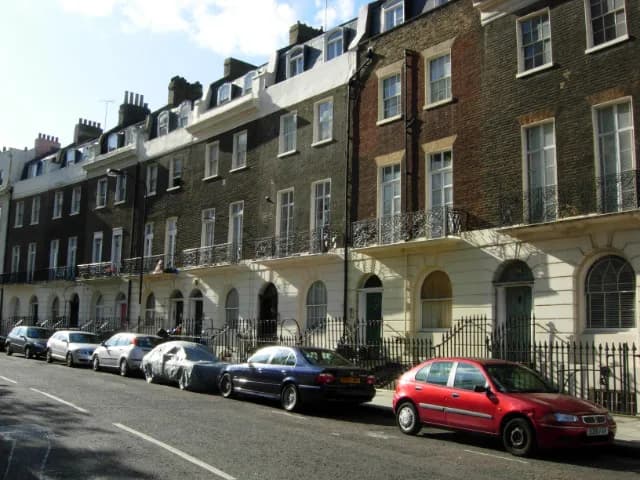
In 1822, the Dickens family moved from Kent to London and settled in a house in Bayham Street, Camden Town. Charles was about ten years old, and he later recalled the dwelling as a "mean, small tenement" where he felt the isolation of what his biographer John Forster described as "struggling poverty." The family later moved to 29 Johnson Street, now Cranleigh Street, in Somers Town, where they remained for four years before relocating in November 1828 to 17 The Polygon, also in Somers Town.
Boarding at College Place and the Wellington House Academy
When John Dickens was imprisoned for debt in the Marshalsea in 1824, twelve-year-old Charles was sent to board with Elizabeth Roylance at 112 College Place, Camden Town. Roylance later became the model for the formidable Mrs. Pipchin in Dombey and Son. Between roughly 1825 and March 1827, Dickens attended the Wellington House Academy in Camden Town. He drew on its disordered teaching and harsh discipline when creating Mr. Creakle's Establishment in David Copperfield.
Doughty Street: A Surviving House and a Burst of Creativity
On 25 March 1837, Dickens took a three-year lease at £80 per year on 48 Doughty Street in Holborn, within the London Borough of Camden. He lived there with his wife Catherine, their first three children, his brother Frederick, and Catherine's sister Mary Hogarth. Both Mary Dickens and Kate Macready Dickens were born in the house. It was also the scene of tragedy: Mary Hogarth died there in 1837 after a brief illness, passing away in Dickens's arms. Her death caused him to miss deadlines for The Pickwick Papers and Oliver Twist, and she is widely credited with inspiring the characters of Little Nell and Rose Maylie.
During his time at Doughty Street, Dickens completed The Pickwick Papers, wrote the whole of Oliver Twist and Nicholas Nickleby, and began work on Barnaby Rudge. The property is now his only surviving London home.
Camden in the Novels: Cratchits, Micawbers, and Skimpole
Camden's geography appears explicitly in several of Dickens's major works. In A Christmas Carol, Bob Cratchit's family lives in Camden Town. In David Copperfield, the ever-hopeful Micawbers reside in Camden Town and, more specifically, on Johnson Street, now Cranleigh Street, in Somers Town, where the character Traddles lodges with them. The Polygon in Somers Town appears in Chapter 52 of The Pickwick Papers, and in Bleak House it is the home of the artful Harold Skimpole.
Dombey and Son includes a description of the building of the London and Birmingham Railway as it passes through Camden Town. In A Tale of Two Cities, the informer Roger Cly is buried in Old St Pancras Churchyard, where Jerry Cruncher and his companions later attempt to "resurrect" him. The St Pancras Workhouse also has a literary connection: Robert Blincoe, whose early life as a child inmate there may have influenced Oliver Twist, was once resident in the institution. In Our Mutual Friend, Nicodemus Boffin's inherited wealth traces back to a dust-contractor fortune made at Somers Town.
The Dickens Museum Today
The Dickens Fellowship, founded in 1902, purchased the freehold of 48 Doughty Street in 1923 to save it from demolition. The house opened as a museum in 1925 and is now Grade I listed. Its collection includes first editions, original manuscripts, letters, and Dickens's only known surviving item of clothing, a Court Suit and sword worn when he was presented to the Prince of Wales in 1870. Among its best-known exhibits is the unfinished painting Dickens's Dream by R. W. Buss.