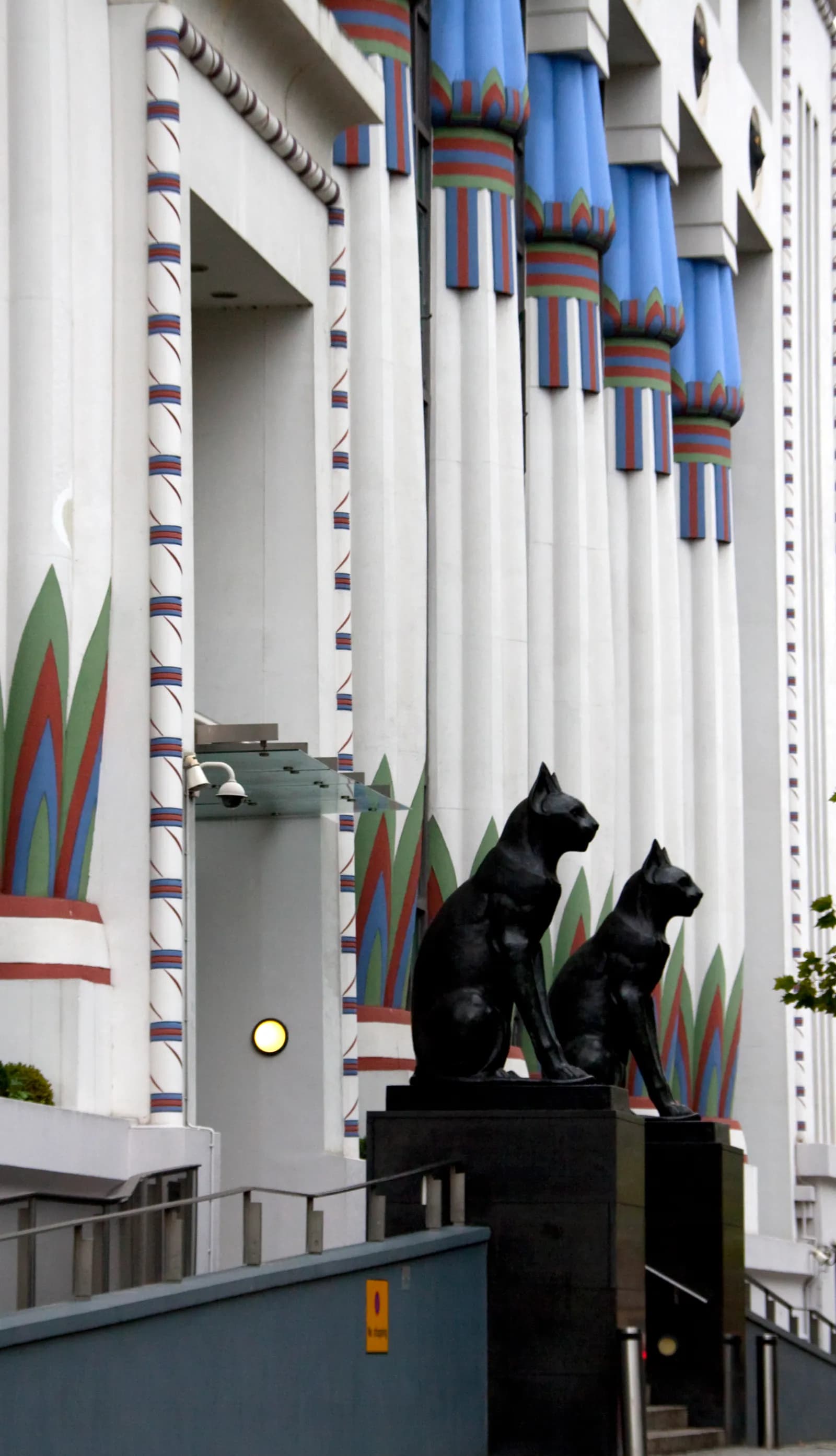
Rising above the Mornington Crescent terrace, the former Carreras Cigarette Factory stands as one of London's most extraordinary industrial monuments. The 550-foot façade combines Art Deco sophistication with Egyptian Revival splendour, a confection of papyriform columns, serpent handrails and guardian cat statues that continues to stop passers-by in their tracks.
The Opening Spectacle of 1928
The factory opened in 1928 following a two-year construction period that replaced Carreras Tobacco Company's cramped Arcadia Works on City Road. The opening ceremony on Hampstead Road reportedly involved pavements covered in sand to replicate Egyptian deserts, a procession of cast members from Verdi's opera Aida, actors in Ancient Egyptian costume, and a chariot race held along the road.
The Carreras Tobacco Company had outgrown its previous premises by 1927, spurred by post-First World War demand for cigarettes. The firm traced its origins to 1788, when Don José Carreras Ferrer, a Spanish nobleman, began producing tobacco products. The company became a public concern on 6 June 1903, with Russian-Jewish inventor and philanthropist Bernhard Baron joining as director. Baron, who had invented a cigarette-making machine in the United States before moving to England in 1895, became chairman in 1905 and remained the company's largest shareholder until his death in 1929.
The Egyptian Design Elements
The building's Egyptian Revival architecture emerged from the cultural phenomenon of "Egyptomania" that swept Britain following Howard Carter's 1922 discovery of Tutankhamun's tomb. The 1925 Paris Exhibition and British Museum displays further fuelled interest in Ancient Egyptian aesthetics, while Hollywood portrayals of the ancient civilisation captured public imagination.
Principal architects Marcus Evelyn Collins and O.H. Collins, working with Arthur George Porri, designed a façade faced in Atlas White cement, coloured to resemble sand. Twelve large papyriform columns, inspired by tombs at Amarna, were painted in bright colours with Venetian glass decoration. The main entrance, approached by a staircase with serpent-shaped handrails mounted on walls featuring bronze human hands, was designed as a tent structure with cavetto-moulded lintels in Old Kingdom style.
The building originally featured a carved Horus of Behdet; a winged disk of the Sun; above the doorway. This was removed during the Second World War as it resembled Nazi eagle imagery and was never replaced during subsequent restorations. Cow-horned Hathor lamps once stood before the cat statues, and ornamental railings featured Egyptian hieroglyphs. The black cat motif appeared repeatedly across the façade, reflecting the company's corporate identity.
The Cats of Camden
Two bronze cat statues, each 8.5 feet high, flank the building's entrance. These stylised representations of the Egyptian goddess Bastet (also known as Bubastis) were cast at Haskins Foundry in London. The original building name was intended to be "Bast House," though this was abandoned due to its unfortunate similarity to English slang.
The black cat served as the brand device for Craven A cigarettes, one of Carreras's most successful products. The Craven A brand, launched in 1921 as the first machine-made cork-tipped cigarette, bore the slogan "Will Not Affect Your Throat" and was named after the Earl of Craven. The Egyptian imagery associated luxury smoking with the treasures of Ancient Egypt at a time when the Egyptian cigarette industry enjoyed global success from the 1880s until the First World War.
In 1959, following Carreras's 1958 merger with Rothmans of Pall Mall, the original bronze cats were removed. One was relocated to the new Basildon works in Essex, whilst the other was exported to Spanish Town, Jamaica. The replicas now standing at Mornington Crescent were installed during the 1990s restoration.
A Factory Ahead of Its Time
The Carreras building represented a significant advance in industrial architecture. It was the first factory in Britain to use pre-stressed concrete technology and the first to contain air conditioning and dust extraction plant. The facility attracted royal visitors including the Duke of Windsor (as Prince of Wales), King George VI (as Duke of York), and the Duke of Kent.
Contemporary publications referred to the structure as "London's Wonder Works." The V&A Museum now describes it as a "Tutankhamun's tomb-inspired factory," recognising its place within the Egyptian Revival architectural tradition.
From Cigarettes to Click-and-Buy
Following the 1958 merger, Carreras relocated to a new factory in Basildon, Essex in November of that year. Between 1960 and 1962, the Camden building was converted to offices and renamed Greater London House. During this conversion, virtually all Egyptian decoration was stripped away, leaving a bland Modernist exterior that bore little resemblance to its former glory.
The building's fortunes changed in 1996 when Resolution GLH purchased the property. Architects Finch Forman undertook a comprehensive restoration that recreated approximately 80 to 90 per cent of the original Art Deco features, including replicas of the famous cat statues. The project earned a Civic Trust Award.
The Building Today
Now known officially as Greater London House, the building at 180 Hampstead Road, Mornington Crescent, Camden Town, NW1 7AW houses several major organisations. ASOS.com, the online fashion retailer founded on 3 June 2000 by Nick Robertson, Andrew Regan, Quentin Griffiths and Deborah Thorpe, has maintained its headquarters here since the company's inception. The name ASOS originally stood for "AsSeenOnScreen," reflecting the company's initial focus on celebrity-inspired fashion.
Other current tenants include the British Heart Foundation, Wunderman Thompson, WPP plc, Revlon, and Radley & Co. The building has also achieved a degree of screen recognition, featuring in the BBC comedy series W1A as the offices of Fun Media.
The structure occupies the northern end of Hampstead Road, facing out over Harrington Square. It was built on the former communal garden area of Mornington Crescent, the curved terrace of 36 houses constructed in the 1820s and named after the Earl of Mornington, brother of the Duke of Wellington. Mornington Crescent tube station, which opened in 1907, takes its name from this street.
The Carreras Cigarette Factory remains a striking contrast to the Victorian terraces that surround it, embodying Camden's layered history from 1820s residential development through 1920s industrial ambition to twenty-first-century digital commerce. The restored Egyptian temple façade continues to serve as one of north London's most recognisable and photographed landmarks.