Camden Market stands as London's fourth-most popular visitor attraction, drawing approximately 250,000 people each week. What began in 1974 as a modest weekly crafts market near Camden Lock has evolved into a sprawling retail empire spanning multiple sites, with its roots stretching back to the Victorian era when the area served as a vital industrial hub.
The Horse Hospital Origins
The Stables Market section of Camden Market occupies a site of significant historical importance: the former Pickfords stables and a Grade II listed Victorian horse hospital. Pickfords, the historic removal and logistics company, maintained these stables to house the horses that pulled their distribution vans and barges along the Regent's Canal. The horse hospital provided veterinary care for these working animals, which formed the backbone of goods transportation in an era before motorised transport dominated.
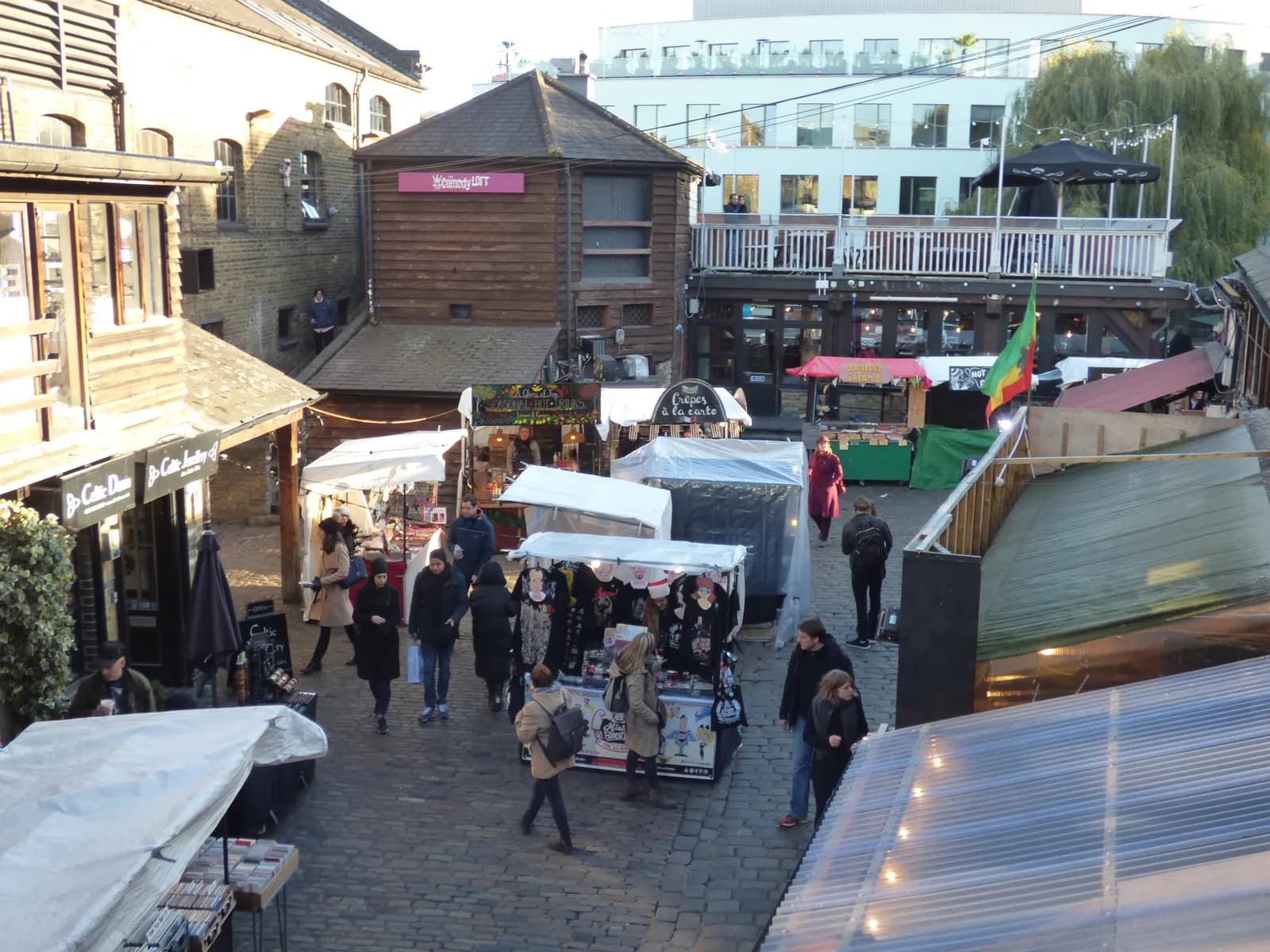
The Victorian infrastructure, with its railway viaduct arches and cobbled yards, remains a defining feature of the market's character today. Visitors walking through the Stables Market walk in the literal footsteps of Victorian horses, past ironwork and brick archways that once echoed with the sounds of hooves and harnesses.
From Industrial Decline to Market Birth
The transformation from industrial hub to retail destination began in the early 1970s. On 30 March 1974, a small weekly crafts market began operating near Camden Lock. This modest beginning coincided with the decline of Camden's industrial heritage along the canal. The timing proved fortuitous: in 1976, plans for a northern urban motorway that would have sliced through the market site were abandoned, allowing the nascent market to establish itself as a permanent feature of the area.
The market's early identity was shaped by Camden's thriving music scene of the 1960s and 70s. Venues such as Dingwalls and the Roundhouse drew creative crowds, and the market naturally evolved to cater to this audience with alternative fashion, crafts, and a distinctly bohemian atmosphere.
Expansion and Consolidation
The market grew steadily throughout the late 20th century. In 1991, a three-storey indoor market hall designed by architect John Dickinson opened at Camden Lock Market, providing covered trading space and signalling the market's transition from purely outdoor stalls to a more complex retail environment.
The Stables Market emerged as a distinct entity within the larger complex, occupying the historic Pickfords site with its railway viaduct arches. This section developed a reputation for alternative fashion, with shops catering to goth and cybergoth subcultures, including well-known traders such as Black Rose and Cyberdog. The market also became a destination for furniture, household goods, ethnic items, and vintage clothing.
By the early 2000s, Camden Market had become a collection of interconnected markets rather than a single entity. In 2006, a large indoor market hall was constructed between Camden Lock Market and the Stables Market, physically linking these previously separate areas. The following year, a significant portion of the Stables Market was demolished and rebuilt as a year-round permanent market area as part of a long-term redevelopment plan.
Fires and Rebuilding
The market's history has not been without setbacks. In 2008, a devastating fire at the Canal Market (later known as Camden Lock Village), caused by unauthorised use of a liquefied petroleum gas heater, destroyed a significant portion of the market. The area reopened in 2009 as Camden Lock Village. Another fire struck the Camden Stables Market in 2014.
A more serious incident occurred in 2017 when a large fire broke out at Camden Lock Market, requiring significant firefighting resources and causing substantial damage. The market demonstrated resilience in each case, rebuilding and reopening to continue trading.
Corporate Ownership and Modern Development
The market's scale and profitability attracted significant commercial interest. In 2014, Israeli billionaire Teddy Sagi began acquiring property in the Camden Market area. By March 2015, he had purchased four of the six market sections and announced plans to invest £300 million in development by 2018. This acquisition marked a new chapter in the market's commercial evolution.
Under Sagi's ownership, substantial redevelopment took place. The former Canal Market and Camden Lock Village site was transformed into Hawley Wharf, a four-storey covered structure comprising sixty fast-food providers, 150 shops, co-working offices, and 200 residential homes. The first Hawley Wharf sites began opening in 2021.
Other sections underwent similar modernisation. Buck Street Market, formerly an outdoor market focused on clothing, reopened as a multi-floor structure. The Electric Ballroom, a nightclub since the 1950s that had previously hosted a weekend market, saw its market operations cease in 2015.
In 2016, Urban Markets Company acquired Camden Lock and announced a £20 million makeover. However, in 2022, Sagi's company LabTech offered the markets for sale, with an asking price of approximately £1.5 billion. The sale included not just retail spaces but also housing, co-working facilities, and Babylon Park, a leisure centre.
The Market Today
Contemporary Camden Market comprises several distinct areas, each with its own character. Camden Lock Market, situated by the Regent's Canal, maintains its original crafts focus whilst also offering books, clothing, jewellery, and fast food. The Stables Market continues to occupy the historic Pickfords site, featuring stalls and shops within railway viaduct arches and retaining its reputation for alternative fashion and subcultural appeal.
Hawley Wharf represents the market's most modern incarnation, offering a covered retail and dining environment alongside residential and office space. The North Yard features independent restaurants and bars in a cobbled yard surrounded by Grade II listed buildings. The West Yard provides canal-side dining with trending food traders.
Inverness Street Market, historically a produce market serving local residents, has transitioned to stalls catering primarily to visitors, including fast food outlets. This shift reflects the broader transformation of Camden from a working-class residential and industrial area to a global tourist destination.
Cultural Significance and Economic Impact
Camden Market's cultural significance extends beyond commerce. It has served as a backdrop for various notable events: in 2004, broadcaster Chris Evans sold many of his possessions on a stall in the Stables Market. The market's reputation for cosmopolitan diversity and alternative culture has made it a symbol of London's countercultural heritage, even as it has become increasingly mainstream and tourist-oriented.
Economically, the market has evolved from temporary stalls to a mixture of stalls and fixed premises, with an increasing proportion operating throughout the week rather than solely at weekends. The integration of residential housing, co-working spaces, and leisure facilities into the market complex reflects broader trends in urban development, where retail, living, and working spaces increasingly overlap.
The market now boasts over 1,000 places to shop, eat, drink, and socialise. Its weekly visitor numbers place it among London's most significant attractions, rivalling established cultural institutions. For Camden itself, the market remains the area's economic engine and primary draw, shaping local property values, business opportunities, and the area's identity.
The Camden Dialectic
Camden Market embodies a tension common to successful urban markets globally: the balance between preserving alternative, independent character and embracing commercial growth and mainstream appeal. The Victorian horse hospital that now houses stalls selling vintage clothing and street food represents one transformation; the evolution from a crafts market serving locals to a global tourist destination drawing a quarter-million visitors weekly represents another.
What began as a practical response to industrial decline, a small market filling the void left by vanishing canal trade, has become something far larger and more complex. The horses that once pulled Pickfords barges have given way to shoppers browsing alternative fashion; the veterinary hospital that cared for working animals now hosts traders catering to global visitors.
This transformation reflects Camden's broader journey from industrial hub to cultural destination. The market's survival through fires, redevelopment, and changing ownership demonstrates its resilience. Its ability to maintain a distinct identity whilst accommodating millions of visitors annually suggests a successful, if occasionally uneasy, balance between the alternative and the commercial.